

An invitation to reconnect with nature in its purest, most undiluted form.
While the Northern Circuit garners the lion’s share of global attention and tourism, the true connoisseurs of the African wilderness cast their gaze south. Tanzania’s Southern Circuit represents a vast, untamed, and fiercely authentic frontier. This region is characterized by its sheer, almost incomprehensible scale, offering a safari experience that feels genuinely exploratory. The parks here are massive—some of the largest protected areas on the entire continent—yet they receive only a fraction of the visitor numbers seen in the Serengeti. For the traveler seeking solitude, rugged beauty, and a deep, undisturbed connection with nature, the Southern Circuit is the ultimate destination.
A journey to the south is a step back in time to the Africa of early explorers. The logistics are slightly more challenging, often relying on light aircraft flights connecting remote airstrips rather than paved roads, but the reward is absolute exclusivity. You will not find convoys of safari vehicles clustered around a single lion kill here. Instead, you will experience the luxury of driving for hours across varied, dramatic landscapes without seeing another human soul, knowing that the only footprints you encounter belong to the wildlife.
The complete guide to Southern Circuit Experience.
 I.
I.
Nyerere National Park (Formerly The Selous)
Nyerere National Park (Formerly The Selous)
The cornerstone of the Southern Circuit is Nyerere National Park. Carved from the northern section of the historic Selous Game Reserve, Nyerere is Africa's largest national park, covering a staggering 30,000 square kilometers (11,500 square miles). This massive area is a UNESCO World Heritage site, recognized for its immense ecological significance and undisturbed wilderness.
The lifeblood of Nyerere is the Rufiji River, a massive, meandering waterway that cuts through the heart of the park before emptying into the Indian Ocean. The Rufiji creates a complex network of channels, swamps, and lakes that dictates the rhythm of life in the park. Because of this abundant water, Nyerere offers a safari experience that is fundamentally different from the dry plains of the north: the boat safari.
Drifting silently along the Rufiji River in a flat-bottomed boat is a magical experience. You will navigate past massive pods of hippopotamuses—the river boasts one of the largest hippo populations in Africa—and glide dangerously close to enormous Nile crocodiles sunning themselves on the muddy banks. The riverbanks are a magnet for thirsty wildlife, offering excellent views of elephants coming down to drink and bathe. Birdlife along the river is phenomenal, featuring dense colonies of colorful carmine bee-eaters nesting in the steep riverbanks, elegant African skimmers, and majestic fish eagles.
 II.
II.
Ruaha National Park: The Baobab Wilderness
Ruaha National Park: The Baobab Wilderness
If Nyerere is defined by water, Ruaha National Park is defined by its rugged, arid beauty and its ancient baobab trees. As Tanzania's second-largest national park, Ruaha represents a unique ecological transition zone where the flora and fauna of eastern and southern Africa overlap. This results in a staggering diversity of species.
The Great Ruaha River runs along the park's eastern boundary. During the dry season, the river shrinks to a series of deep pools, becoming the sole source of water for thousands of square miles. The wildlife concentrations around these remaining water sources become intensely high, setting the stage for spectacular predator-prey interactions.
Ruaha is famous for its massive elephant population, but it is perhaps best known for its predators. The park supports roughly 10% of the world's remaining lion population. The prides here are large and specialized in taking down large prey, including buffalo and even giraffes. Ruaha is also one of the few places where you can reliably spot both the greater and lesser kudu—beautiful, spiral-horned antelopes—as well as the sable and roan antelopes.
An invitation to reconnect with nature in its purest, most undiluted form.
 III.
III.
Mikumi and Udzungwa: The Accessible South
Mikumi and Udzungwa: The Accessible South
While Nyerere and Ruaha require flights or long drives, the Southern Circuit also features more accessible gems. Mikumi National Park, intersected by the highway connecting Dar es Salaam to the interior, is often considered a "mini-Serengeti." Its open Mkata Floodplain provides excellent, easy game viewing of elephants, giraffes, zebras, and lions, making it a popular weekend getaway or an excellent introductory park for a longer southern itinerary.
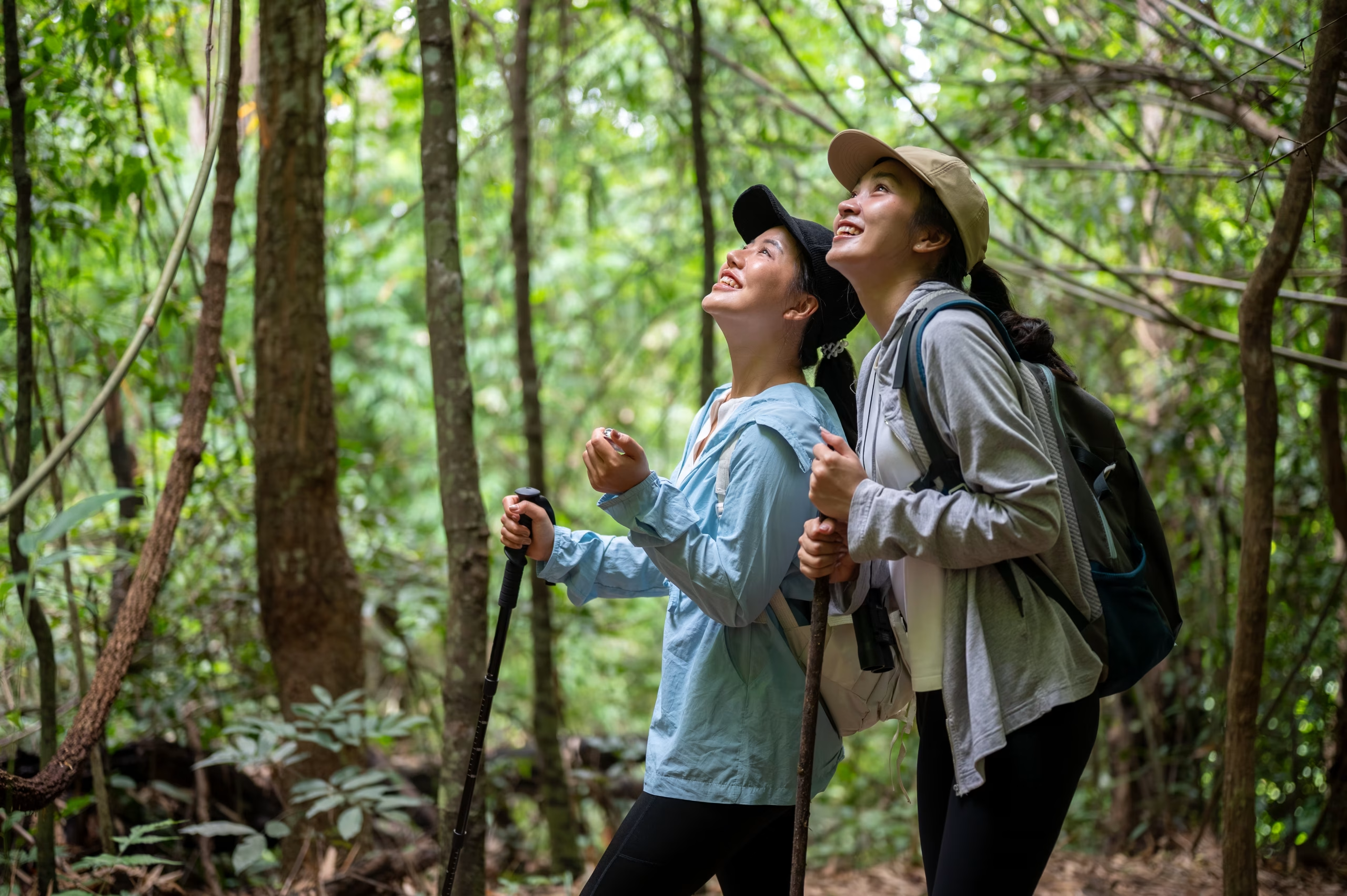
Bordering Mikumi are the Udzungwa Mountains. This national park is entirely unique as it is not a traditional vehicle-based safari destination, but rather a hiker's paradise. The Udzungwa Mountains are part of the Eastern Arc range, often dubbed the "Galapagos of Africa" due to their incredibly high rates of endemism (species found nowhere else on earth). Trekking through the dense, pristine rainforests to the spectacular 170-meter Sanje Waterfall is the main attraction. The forests are home to several primate species found only here, including the Udzungwa red colobus and the Sanje crested mangabey.

 IV.
IV.
The Luxury of Solitude
The Luxury of Solitude
The accommodations across the Southern Circuit perfectly reflect the wild, remote nature of the region. Unlike the large, hotel-style lodges sometimes found in the north, the south is dominated by small, intimate, and highly exclusive tented camps. Many of these camps feature fewer than ten tents, ensuring a highly personalized experience.
Because the visitor density is so low, the guiding in the south is often exceptional. The guides here are true bushmen, adept at tracking and interpreting the subtle signs of the wilderness. The regulations in these parks (particularly in the areas that were formerly part of the Selous Game Reserve) are often more flexible than in the northern national parks. This allows for activities that are rare elsewhere, such as off-road driving to follow a predator hunt, and most notably, highly immersive walking safaris. Walking in Ruaha or Nyerere, accompanied by an armed guide, is the ultimate way to connect with the landscape, understanding the micro-ecosystems and feeling the vulnerability that early explorers must have felt.
 V.
V.
Planning Your Southern Expedition
Planning Your Southern Expedition
A safari in the Southern Circuit is best suited for the traveler seeking a deeper, more rugged, and exclusive experience. Because the distances are vast and the roads can be challenging, we highly recommend utilizing the excellent network of light aircraft flights that connect Dar es Salaam or Zanzibar directly to the dirt airstrips within Ruaha and Nyerere.
A classic southern itinerary typically involves three to four nights in Nyerere to experience the boat safaris and the lush, riverine environment, followed by a flight to Ruaha for another three to four nights to explore the arid baobab landscapes and track the massive lion prides.
Because the Southern Circuit is naturally closer to the coast, it pairs perfectly with a post-safari beach extension to Zanzibar, Mafia Island, or the pristine Swahili coastline south of Dar es Salaam. The Southern Circuit is not just a destination; it is an immersion into the wild, beating heart of Africa, a place where nature still dictates the rules and the sense of adventure is palpable in the dusty air.
The ways to experience Southern Circuit Experience.
Begin your journey.
Tell us which journey feels closest and we will shape it around you — dates, pace, the kind of camps you sleep best in.