

Discoverthe extraordinary.
Experience the absolute best of Olduvai Laetoli with our tailored, expert-led itineraries.
What makes Olduvai Laetoli Experience unforgettable.
 Step 1
The Legacy of the Leakeys
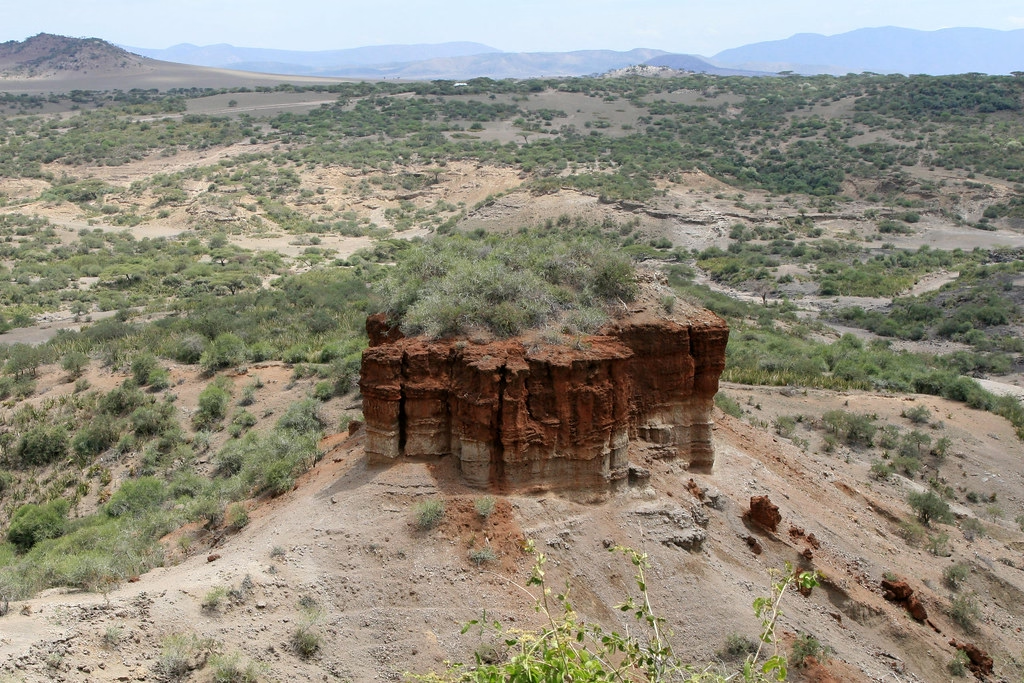
The story of Olduvai Gorge is inextricably linked to the pioneering work of Mary and Louis Leakey, a husband-and-wife team of paleoanthropologists who dedicated their lives to uncovering the secrets of human evolution in East Africa. Beginning their excavations in the 1930s, the Leakeys spent decades working in incredibly harsh and isolated conditions, meticulously sifting through the dust and rock of the gorge.
Their perseverance culminated in a series of groundbreaking discoveries that fundamentally shifted the scientific understanding of human origins, proving conclusively that humanity's earliest ancestors originated in Africa. In 1959, Mary Leakey made the spectacular discovery of a nearly complete skull of Paranthropus boisei, initially nicknamed "Nutcracker Man" due to its massive jaw and teeth, and officially named Zinjanthropus boisei. Shortly after, the Leakeys discovered the remains of Homo habilis ("Handy Man"), a more direct ancestor to modern humans, so named because the fossils were found alongside some of the earliest known stone tools. These discoveries put Olduvai Gorge on the global map and established it as a site of paramount scientific importance.
 Step 2
The Laetoli Footprints: A Walk Through Time
Approximately 45 kilometers south of Olduvai Gorge lies the Laetoli site, an area that holds what is arguably an even more evocative piece of our evolutionary history. In 1978, Mary Leakey and her team discovered a trail of fossilized hominin footprints perfectly preserved in a layer of volcanic ash.
These footprints, dated to approximately 3.6 million years ago, are widely attributed to Australopithecus afarensis (the same species as the famous "Lucy" skeleton found in Ethiopia). The footprints are astonishingly clear, showing the distinct impression of a heel strike, a well-developed arch, and a big toe aligned with the other toes—all hallmarks of obligate bipedalism. They provide the earliest incontrovertible evidence that our ancestors were walking upright on two legs millions of years before the development of stone tools or significant brain expansion. While the original footprints are kept covered to protect them from the elements and erosion, a highly detailed cast is on display at the Olduvai Gorge Museum, allowing visitors to walk alongside the ghosts of our distant past.
 Step 3
The Olduvai Gorge Museum
In recent years, the visitor experience at Olduvai Gorge has been vastly improved with the construction of a modern, beautifully designed museum right on the rim of the gorge. Funded heavily by the European Union and the Tanzanian government, the museum is architecturally striking, designed to resemble a traditional Maasai boma while offering state-of-the-art exhibition spaces.
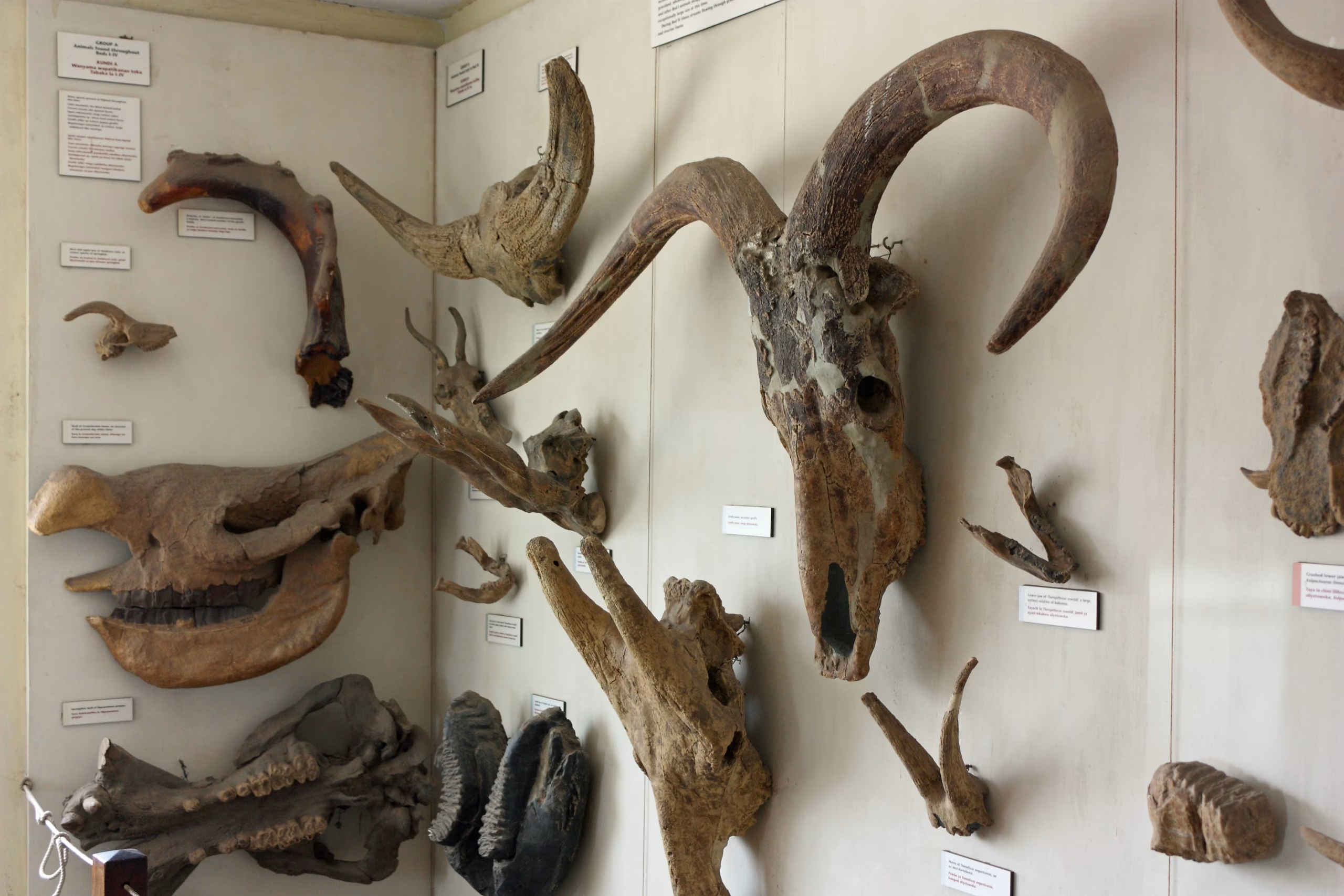
The museum houses an impressive collection of artifacts, fossils, and interactive displays that detail the geological history of the gorge and the evolutionary timeline of the hominin species found there. You can view excellent replicas of the Zinjanthropus and Homo habilis skulls, examine the progression of Oldowan stone tool technology, and study the cast of the Laetoli footprints. The museum also features a section dedicated to the incredible diversity of prehistoric animal fossils discovered in the gorge, including giant short-necked giraffes, massive elephants, and extinct species of horses and pigs, painting a vivid picture of the ecosystem our ancestors inhabited.
 Step 4
The Phenomenon of the Shifting Sands
A short drive from the Olduvai Gorge Museum, deeper into the Ngorongoro Conservation Area, lies a bizarre and fascinating geological phenomenon known as the Shifting Sands. This is a remarkable, solitary barchan dune—a crescent-shaped dune of fine, dark volcanic ash that moves slowly but continuously across the grassy plains.
The ash originally erupted from the nearby active volcano, Ol Doinyo Lengai (the "Mountain of God" to the Maasai). Caught by the prevailing easterly winds, the dune maintains its perfect crescent shape as it marches westward at a rate of approximately 17 meters (55 feet) per year. The sand is highly magnetized, meaning that if you grab a handful and toss it into the air, the wind will not scatter it; instead, the particles clump together and fall back onto the dune. It is a surreal, otherworldly sight and serves as a stark reminder of the active volcanic forces that created the landscape of the Serengeti and preserved the fossils of Olduvai.
 Step 5
Planning Your Visit and Logistics
A visit to Olduvai Gorge is incredibly easy to incorporate into a standard northern Tanzania safari itinerary. Because it is located directly on the main transit route between the Ngorongoro Crater and the Serengeti National Park, it serves as a perfect, natural breaking point for the long drive.
Most visitors spend about an hour or two at the site. This allows ample time to tour the museum, listen to a brief lecture from one of the resident resident guides (often members of the local Maasai community or students of archaeology), and take in the sweeping, panoramic views of the gorge from the observation deck. For those with a deeper interest, it is sometimes possible to arrange special excursions down into the gorge itself, though this requires advance planning and specific permits. A stop at Olduvai provides a profound intellectual and historical contrast to the purely wildlife-focused activities of a typical safari, enriching your understanding of the land you are traveling through.
An invitation to reconnect with nature in its purest, most undiluted form.
The ways to experience Olduvai Laetoli Experience.
Begin your journey.
Tell us which journey feels closest and we will shape it around you — dates, pace, the kind of camps you sleep best in.